
Psychological horrorHorror puzzleSurreal horrorMystery and detective horror
Nevermind
Rate itExplore a trauma patient's mind while the game watches your fear.
- Platforms
- PC, Mac, Xbox, VR
- Stores
- Steam
- Price
- Paid
- Rated
- Mostly Positive on Steam (75% of 347 reviews); Metascore 65 on Xbox One from 7 critic reviews
- Length
- about 4 hours
- Players
- 1
- Controls
- Keyboard and mouse or controller; VR headsets supported; optional webcam, heart-rate sensor or eye tracker for biofeedback
- Made by
- Flying Mollusk
- Released
- 2015
On Mac: one of the Mac horror games.
No. 14 of the desert horror games · No. 13 of the doctor horror games
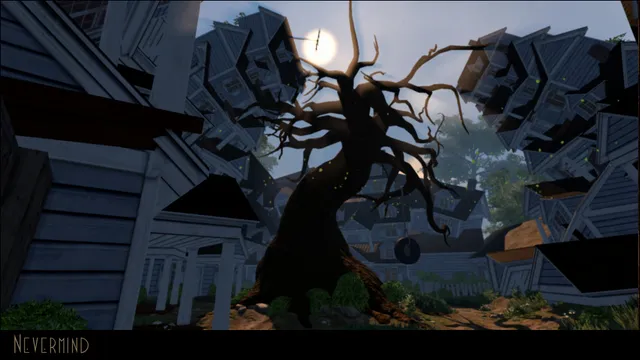
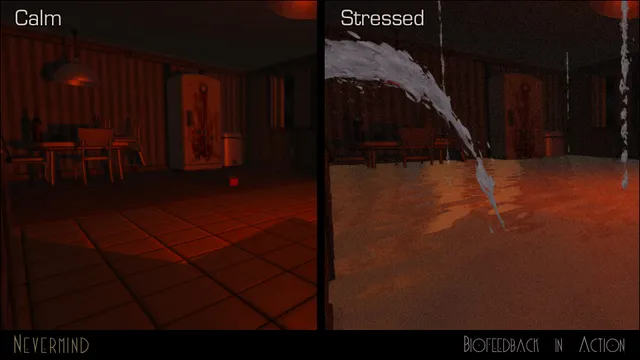
What frightens As a doctor who can enter patients' minds, you explore the surreal worlds of their subconscious, warped towns, walls of screaming faces, trees hung with dolls, to uncover the trauma each one has buried. With a webcam or heart-rate sensor the game watches your fear: if anxiety wins, the screen grows foggy and unsteady and the puzzles get harder, and staying calm is the way through.
Content: depictions of trauma, violence and assault (the store warns), blood, sexual themes, partial nudity, strong language, drug use, disturbing imagery, optional webcam reads your face.
Nevermind is a biofeedback psychological horror game by Flying Mollusk, released on PC and Mac in 2015 and on Xbox One in 2017. You enter the subconscious of trauma patients to solve puzzles and find the memories they have buried, while a webcam or heart-rate sensor reads your fear and makes the game harder when it rises.
About Nevermind
Nevermind is made and published by Flying Mollusk. It came out on Steam on 29 September 2015 for Windows and Mac, with VR support, and on Xbox One on 11 January 2017. It began as Erin Reynolds' graduate thesis at the University of Southern California, and the full game was funded on Kickstarter in late 2014 after a first campaign fell short. It is best known for its biofeedback: with almost any webcam, or a heart-rate sensor such as an Apple Watch or a chest strap, the game reads signs of fear, tension and anxiety as you play.
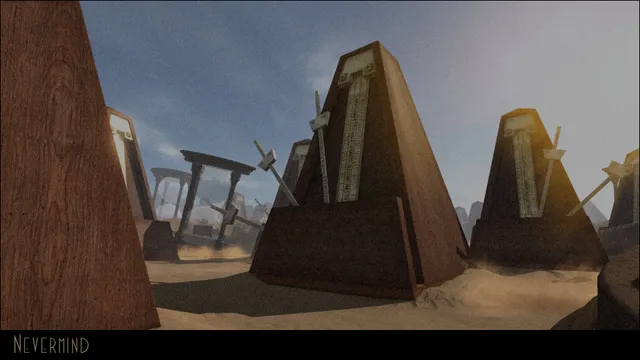
You are a Neuroprober, a doctor newly hired by the Neurostalgia Institute who can enter the minds of patients whose trauma ordinary treatment has not reached. Each case is a surreal, darkly beautiful place built from memory: a yard ringed by tilted, warped houses, a desert of giant metronomes, a forest of trees hung with baby dolls, a room walled with screaming faces. You explore in first person, solve puzzles and look for the ten photographs in each mind that hold the pieces of what really happened. The deeper you go, the more the patient's mind fights back.
The twist is that the game reacts to you. If your fear gets the best of you, it becomes harder, the screen turning foggy and unsteady so you can hardly find your way; if you can calm yourself in the face of the horror, it becomes more forgiving. Its makers present it as a way to practise managing stress, and the store warns that it depicts violence, assault and other traumatic situations. Without a sensor it still plays as an atmospheric mystery, and the Xbox version has no biofeedback at all.
It suits players who want psychological horror that is more about unsettling places and a story to piece together than jumpscares, and anyone curious to see their own fear measured. A first run takes around four hours.
How to play Nevermind
- Buy Nevermind on Steam for Windows or Mac, or on Xbox (without biofeedback).
- Optionally connect a webcam or a supported heart-rate sensor for biofeedback, or play in a VR headset.
- Enter each patient's mind and explore it in first person.
- Solve the puzzles and find the photographs that hold the memories behind their trauma.
- Keep calm: the more anxious you get, the harder the game becomes.
Screenshots




Tips
- You do not need a heart-rate sensor; almost any webcam enables the emotion-based biofeedback, though not when you play in VR.
- Take slow breaths when the screen starts to blur and shake; calming down eases the challenge.
- Each mind hides ten photographs; they are the memories you need to piece the case together.
- Have a keyboard to hand even with a controller: you type the doctor's name when you register.
Questions
Do you need a heart-rate monitor for Nevermind?
No. Almost any webcam enables its biofeedback on Windows and Mac, and without a webcam or sensor the game still plays fully as an atmospheric mystery.
Is Nevermind scary?
It is unsettling and surreal rather than full of jumpscares, but it deals with real trauma; the store warns of violence and assault, and the ESRB rates it M for blood, violence, sexual themes and drug use.
How long is Nevermind?
PlayThis puts the main story at about four hours.
Does the Xbox version have biofeedback?
No. Flying Mollusk describes the Xbox One release as a non-biofeedback version, sold in some regions.
Ratings and reviews
If Nevermind frightened you

The Infectious Madness of Doctor Dekker
You treat troubled patients too, uncovering what they hide session by session.
PC / Mac / Linux / PlayStation / Xbox / Switch

Layers of Fear
A nightmare built from one mind, in a house that changes when you turn around.
PC / Mac / PlayStation / Xbox / Switch

Smile For Me
Nod, shake your head, and find out what Doctor Habit is hiding.
PC / Mac / Switch / PlayStation / Xbox

Cube Escape Collection
Nine strange rooms, one dead woman and the mystery of Rusty Lake.
PC / Mac / iPhone / Android
More psychological horror games
- A monster doesn't let me leave my room
- a pet shop after dark
- Aephemera
- Amelie
- Amnesia: A Machine for Pigs
- Amnesia: The Dark Descent
- Among the Sleep
- ANATOMY
- Anthology Of The Killer
- Asleep: Act 1
- Assessment Examination
- ASYLUM